

Why We Chose to Harvest Entirely by Hand
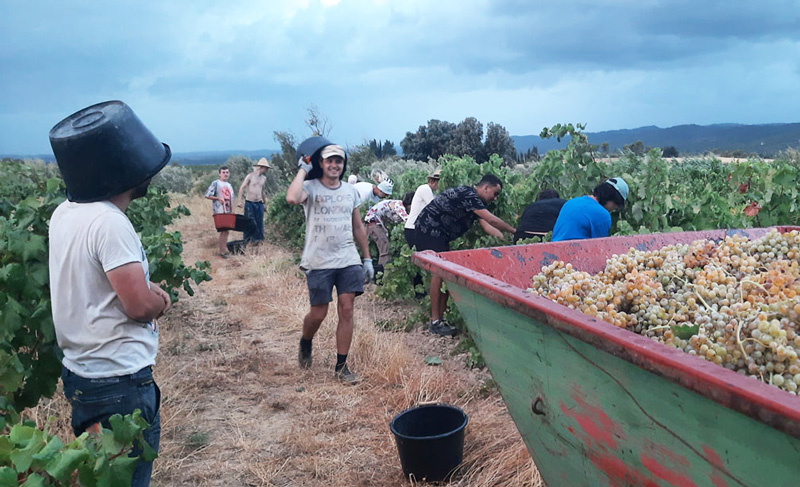
For the first time in more than 40 years, all of the Pech d’André vineyards were harvested by hand this year.
The grape-harvesting machine arrived at the estate in 1985. Since then, it has always been part of our harvests, to varying degrees.
In recent years, we had already been gradually increasing the proportion of grapes harvested by hand. For the past three years, about two-thirds of our grapes have been picked by hand, with the remaining third still harvested by machine.
In 2026, we took the plunge: 100% of our grapes were harvested by hand.
We had wanted to do this for a long time. But with more than 30 hectares to harvest, one thing held us back: the cost.
Hand-harvesting is significantly more expensive than mechanical harvesting. And in this time of deep crisis for the wine industry, deciding to increase costs may seem contradictory. Especially since our machine is old, has long since been paid off, and could still do the job.
Nevertheless, we chose to stop using it.
Does hand-harvesting necessarily produce better wine?
Let’s start by dispelling a fairly widespread misconception.
People tend to associate hand-harvesting with fine wine, as if the simple act of cutting a bunch of grapes with pruning shears were enough to make the wine better.
We don’t think so.
When the grapes are healthy and the mechanical harvest is carried out properly, it’s perfectly possible to produce excellent wines using a grape-harvesting machine. Conversely, a manual harvest alone obviously guarantees nothing.
The machine has made the winemakers’ work considerably easier. We have used it ourselves for over forty years, and we have no intention today of denying the benefits it has brought us.
Our decision to return entirely to hand-harvesting stems primarily from another concern: taking care of the vineyard itself.
Caring for a Living Asset
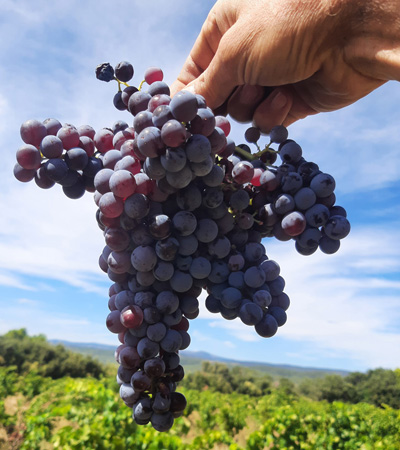
A vine is not merely the source of this year’s harvest.
It is a perennial plant that we nurture year after year, for several decades. Its structure, its living wood, its reserves, and its health determine its ability to withstand the passage of time, diseases, and adverse weather conditions.
We have long since evolved the way we tend to our vines.
In winter, pruning is carried out by our team, trained in gentle pruning—or physiological pruning—by Marceau Bourdarias and the Architectes du Vivant. This method focuses on the plant’s functioning, its sap flow, and the preservation of living wood.
In the spring, debudding is done entirely by hand, vine by vine.
Then, throughout the season, we monitor the vines and strive to support their balance so they can produce healthy, well-balanced grapes without exhausting the plant.
All of this requires a great deal of time and care.
So, having cared for our vines throughout the year, it has become difficult for us to accept mistreating them at harvest time.
What the grape-harvesting machine does to the vine
To remove the grapes, a grape-harvesting machine vigorously and repeatedly shakes the vine.
That’s how it works, and it does so very effectively.
But these jolts also have consequences for the plant. Leaves fall off, shoots may break, and bruises or wounds may appear on the vines. Some are immediately visible, others much less so.
Yet a wound is never entirely harmless to a perennial plant: it must react and compartmentalize the affected tissues. As for the lost leaves, they will no longer contribute to end-of-season photosynthesis or to the building of reserves for the next growing cycle.
Today, we prefer to limit this trauma as much as possible.
This decision is also based on what we observe in our own vineyards. In the vines that we’ve been tending with great care and harvesting by hand for several years, we’re gradually seeing more balanced vines and improving health.
Vines develop over the long term. The effects of a particular practice are not always measurable within a single growing season.
But that is precisely the point: we work with the long term in mind.
Spending More Today to Preserve Tomorrow
That is also where the economic rationale for our decision lies.
Yes, harvesting by hand is more expensive, but cutting costs is not the only way to prepare for a vineyard’s future.
We believe that our future lies in increasingly high-quality wines, produced from vines to which we devote ever more time and attention, but also in preserving the plant heritage that previous generations have passed down to us.
A healthy old vine is irreplaceable.
Caring for our vines is therefore also an investment.
An investment less spectacular than a new machine or a new building, but probably one of the most important we can make.
We are also convinced that we need to bring more farmers back to the fields and create rural jobs. These technical tasks, where human hands provide real added value, are all opportunities to reduce our reliance on machines. Our decision to harvest entirely by hand is thus a modest contribution toward this goal.
And then there’s something more…
Finally, there’s something much less rational.
A grape-harvesting machine is a powerful piece of machinery that moves through the rows, shaking, blowing, and rumbling. It’s efficient.
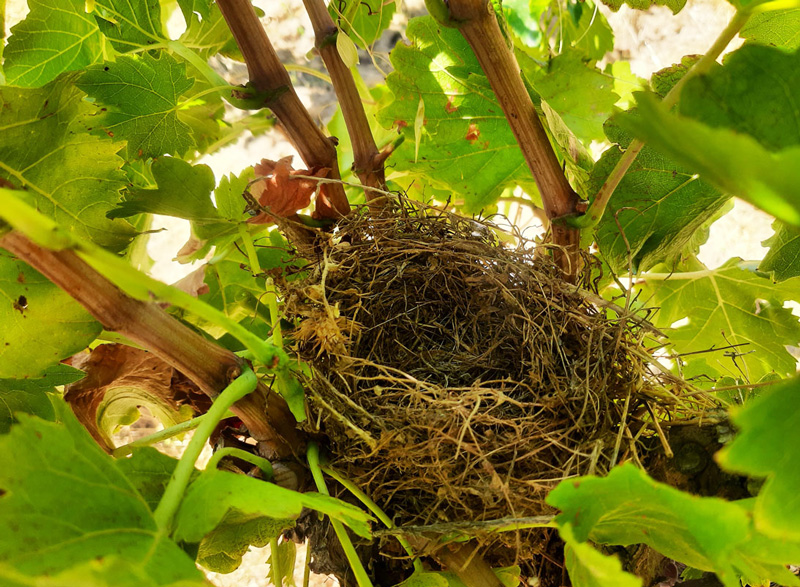
But this enormous, noisy, and raging machine no longer has any place in our vineyards, where we prefer to hear the birds singing and the sound of the wind…
And then there’s the incredible energy that a great team of grape pickers radiates when they set to work in a vineyard. The 2026 “vintage” was exceptional, and his dedication played a major role in making this first harvest once again 100% by hand possible.
The calls from one row to the next, the chatter, the laughter, the sound of grapes falling into the buckets, the carriers passing by, the rows gradually moving forward…
Of course, we can’t prove that this joyful energy is good for the vines… but we’re deeply convinced it is!
To wrap things up, here’s a look back at the 2023 harvest (proof that this joyful energy isn’t just a recent phenomenon!):
Share this content